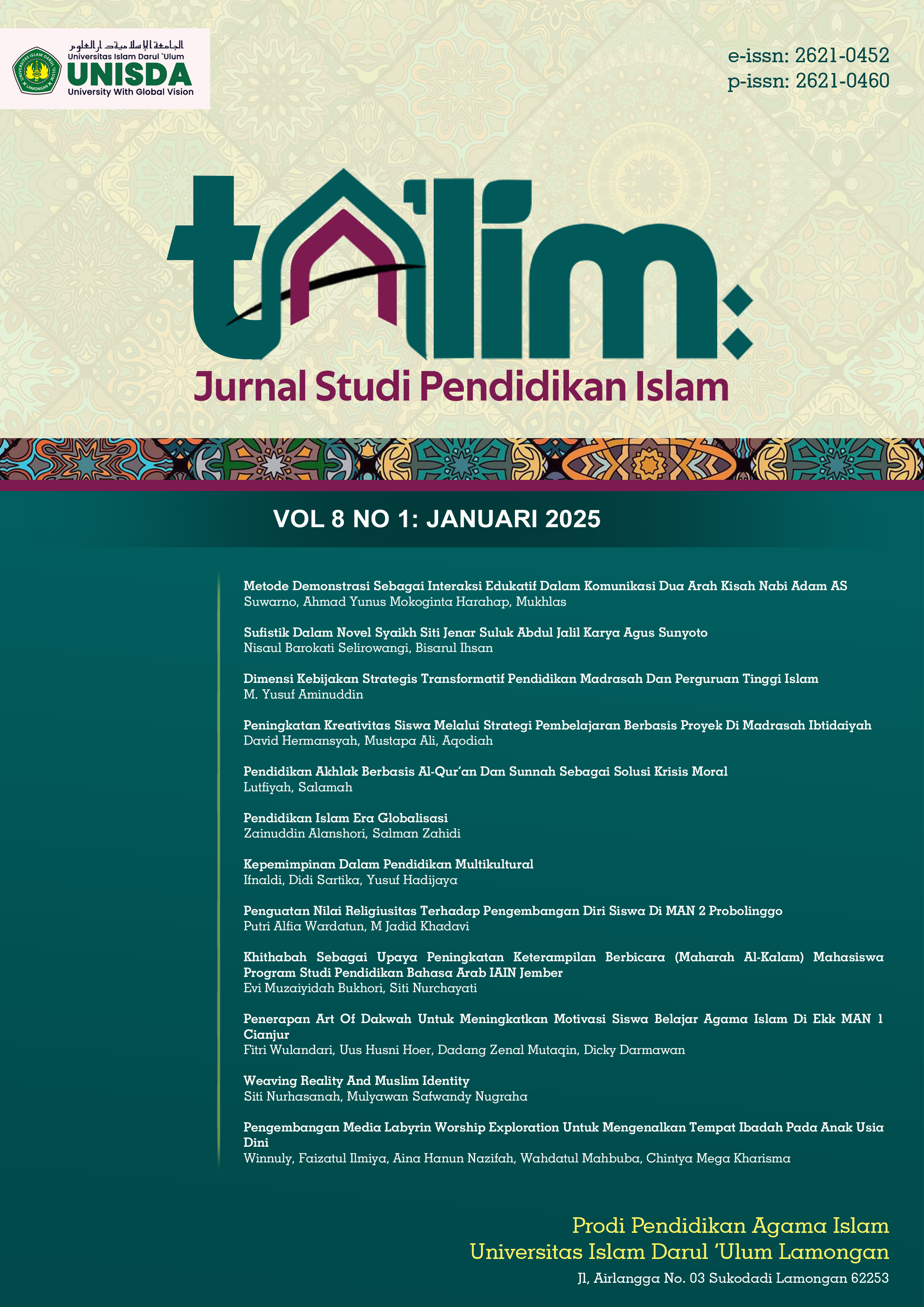
WEAVING REALITY AND MUSLIM IDENTITY
A Case Study Of Students At Najib Bariq Islamic Junior High School
DOI:
https://doi.org/10.52166/talim.v8i1.8760Keywords:
Islamic education, Islamic junior high school, student identityAbstract
This study investigates the factors influencing the formation of Muslim identity among students at Najib Bariq Islamic Junior High School. The research discusses how the role of the family affects the religious identity of students. Limited funding at the school results in restricted extracurricular activities, even though these activities are necessary for developing students' interests and talents beyond academic subjects. The influence of social media and mobile games is also discussed to show how these can distract students from their educational goals. The study aims to highlight the presence of a supportive school environment, structured learning programs, and non-formal activities in enhancing the formation of Muslim identity. Additionally, it addresses ways to overcome the impact of technology and contemporary challenges in instilling Islamic values in education. The findings emphasize a holistic educational approach that integrates Islamic values and meets the needs of today’s society. In this context, it demonstrates that collaboration between schools and families is crucial to prepare students to face modern challenges with a strong self-awareness as Muslims.
Downloads
References
Ahmad, Nafisah, and Isnanita Noviya Andriyani. “Parent Involvement Pada Anak Penghafal Al-Qur’an Di SDIT Muhammadiyah Al-Kautsar.” Academic Journal of Psychology and Counseling 3, no. 1 (April 30, 2022): 73–100. https://doi.org/10.22515/ajpc.v3i1.4358.
Artanti, Kurnia Dwi, Rosaline Dinda Arista, and Tatu Indira Khairunnisa Fazmi. “The Influence of Social Environment and Facility Support on Smoking in Adolescent Males in Indonesia.” Journal of Public Health Research 13, no. 1 (January 2024): 22799036241228091. https://doi.org/10.1177/22799036241228091.
Asmanto, Budi, Suradi Suradi, Andi Warisno, An An Andari, and M Afif Anshori. “The Evolution of Islamic Educational Institutions in Indonesia.” JMKSP (Jurnal Manajemen, Kepemimpinan, Dan Supervisi Pendidikan) 8, no. 1 (February 11, 2023): 262–72. https://doi.org/10.31851/jmksp.v8i1.11117.
Daulay, Afrahul Fadhilah, Shafira Oktaviola, Ade Husna Prabaswara, and Najwa Nabilah. “Peranan Pendidikan Islam dalam Meningkatkan Akhlak Siswa di Sekolah Bidayatul Hidayah IV.” El-Mujtama: Jurnal Pengabdian Masyarakat 4, no. 4 (July 2, 2024): 2018–26. https://doi.org/10.47467/elmujtama.v4i4.3492.
Faizal, Faizal. “Islamic Religious Education Courses as Students Forming Islamic Character.” Jurnal Riset Ilmu Pendidikan 2, no. 3 (July 20, 2022): 192–96. https://doi.org/10.56495/jrip.v2i3.166.
Fatimah, Siti, and Sri Sumarni. “A Holistic Approach to Islamic Basic Education: Synthesizing The Development of Student’s Potential from Intellectual, Spiritual and Emotiona Aspects.” PIONIR: JURNAL PENDIDIKAN 13, no. 2 (August 17, 2024): 106. https://doi.org/10.22373/pjp.v13i2.24259.
Fatmawaty, Fatmawaty, Muh. Askari Zakaria, and Hartono Hartono. “Pengembangan Bahan Ajar Pendidikan Agama Islam Berbasis Kecerdasan Emosional dan Kecerdasan Spiritual Kelas X di SMA IT Wahdah Islamiyah Pomalaa.” Journal on Education 5, no. 4 (February 27, 2023): 11334–44. https://doi.org/10.31004/joe.v5i4.2074.
Islam, Muhammad Syaiful. “Islamic Education Thought Seyyed Naquib Al-Attas.” Al-Fadlan: Journal of Islamic Education and Teaching 2, no. 1 (June 4, 2024): 25–36. https://doi.org/10.61166/fadlan.v2i1.39.
Isnaeni, Dina Nur, Aep Saepudin, and Huriah Rachmah. “Strategi Peningkatan Karakter Religius Peserta Didik Melalui Mentoring Keputrian Di SMA Negeri 5 Bandung.” In Bandung Conference Series: Islamic Education. Bandung: UNISBA, 2024. https://doi.org/10.29313/bcsied.v4i1.12499.
Kambali, Kambali, Muslikh Muslikh, Abas Hidayat, and R Nur Abdurakhman. “Religion in Cyberspace: Islamic Religious Education in Social Media.” Edukasi Islami: Jurnal Pendidikan Islam 12, no. 01 (February 24, 2023). https://doi.org/10.30868/ei.v12i01.3886.
Mufron, Ali, Tenggo Husnul Fata, Akib Akib, Norlaila Norlaila, and Abd. Hadi Rohmani. “The Concept of Islamic Education Today in the Challenges of the Social Media Era.” Al-Hijr: Journal of Adulearn World 3, no. 1 (March 21, 2024): 11–28. https://doi.org/10.55849/alhijr.v3i1.579.
Nik Abdullah, Nik Md. Saiful Azizi, Fathiyah Solehah Mohd Sabbri, and Rabi’atul Athirah Muhammad Isa. “Exploring Students’ Motivation In Tahfiz Class In Selected Private Islamic Secondary Schools: A Case Study.” UMRAN - International Journal of Islamic and Civilizational Studies 9, no. 1 (February 28, 2022): 79–96. https://doi.org/10.11113/umran2022.9n1.510.
Ningsih, Putri Dinia. “Compare and Contrast Paragraph Between Megawati (2016a) & Megawati (2016b),” 2018. http://eprints.umsida.ac.id/id/eprint/1226.
Nuha, Muhammad Ulin. “Motivation of Santri in Memorizing the Holy Qur’an through Murojaah Activities: Study in Roudlothul Qur’an PPAI Complex.” Interdisciplinary Journal of Social Science and Education (IJSSE), September 14, 2023, 39–60. https://doi.org/10.53639/ijsse.v1i1.9.
Oktavia, Oktavia, Yazida Ichsan, Zalik Nuryana, and Azlina Mustaffa. “Involving Parents through Parenting School Programs (PSP) in Islamic Educational Institutions,” Vol. 1, 2020.
Rizki, Najrul Jimatul, and H. Mulyawan S. Nugraha. “Pengaruh Pembelajaran Berbasis Berpikir Kritis Terhadap Peningkatan Prestasi Belajar PAI Di SDIT Adzkia 1 Sukabumi.” Jurnal Arjuna : Publikasi Ilmu Pendidikan, Bahasa dan Matematika 1, no. 4 (August 24, 2023): 166–80. https://doi.org/10.61132/arjuna.v1i4.93.
Rohman, Abdul, Gowhar Meraj, Alizar Isna, Mulyani Mudis Taruna, Arnis Rachmadhani, Nugroho Eko Atmanto, and Nasikhin Nasikhin. “Challenges in Islamic Education Curriculum Development: A Comparative Study of Indonesia, Pakistan, and India.” International Journal of Learning, Teaching and Educational Research 23, no. 6 (June 30, 2024): 504–23. https://doi.org/10.26803/ijlter.23.6.23.
Sodikin, Mohamad, Parmuji Anto, and Khoirul Anwar. “Enhancing Education Quality in Islamic Institution Through Management Approaches.” Evaluasi: Jurnal Manajemen Pendidikan Islam 8, no. 1 (May 13, 2024): 70–81. https://doi.org/10.32478/cwxxya26.
Suyatno, Suyatno, Wantini Wantini, Sukiman Sukiman, and Yulia Rachmawati. “Progressive Islamic Education: Bridging the Gap of Islam, Indonesianness, and Modernity.” The Qualitative Report, 2022. https://doi.org/10.46743/2160-3715/2022.4782.
Tabi’in, As’adut, Lias Hasibuan, and Kasful Anwar Us. “Pendidikan Islam, Perubahan Sosial, dan Pembangunan di Indonesia.” Asatiza: Jurnal Pendidikan 3, no. 1 (January 31, 2022): 48–59. https://doi.org/10.46963/asatiza.v3i1.469.
Taha Alalwani, Ruqaia. “Bridging the Gap Between Theory and Practice In Life of Muslims Today.” مجلة إسهامات للبحوث و الدراسات 1, no. 2 (2017): 250–65.
Ubale, Az, T Abdurrahman, and AH Abdullah. “A Relationship between Parental Involvement and Intrinsic Motivation on Learning Islamic Education.” Arts and Social Sciences Journal 06, no. 03 (2015). https://doi.org/10.4172/2151-6200.1000115.
Yusuf, Moh. Asror. “The Portrait of Religiosity and Nationalism of High School Students in Contemporary Indonesia.” International Journal of Research Publication and Reviews 4, no. 8 (August 2023): 1561–66. https://doi.org/10.55248/gengpi.4.823.49915.
Zakiyah, Maya Mariah. “Character Building Through Growing Spiritual Values Based on The Quran of Surah Al-Muzammil Verses 1-8.” International Journal of Business, Law, and Education 4, no. 1 (February 1, 2023): 25–31. https://doi.org/10.56442/ijble.v4i1.126.












.jpg)