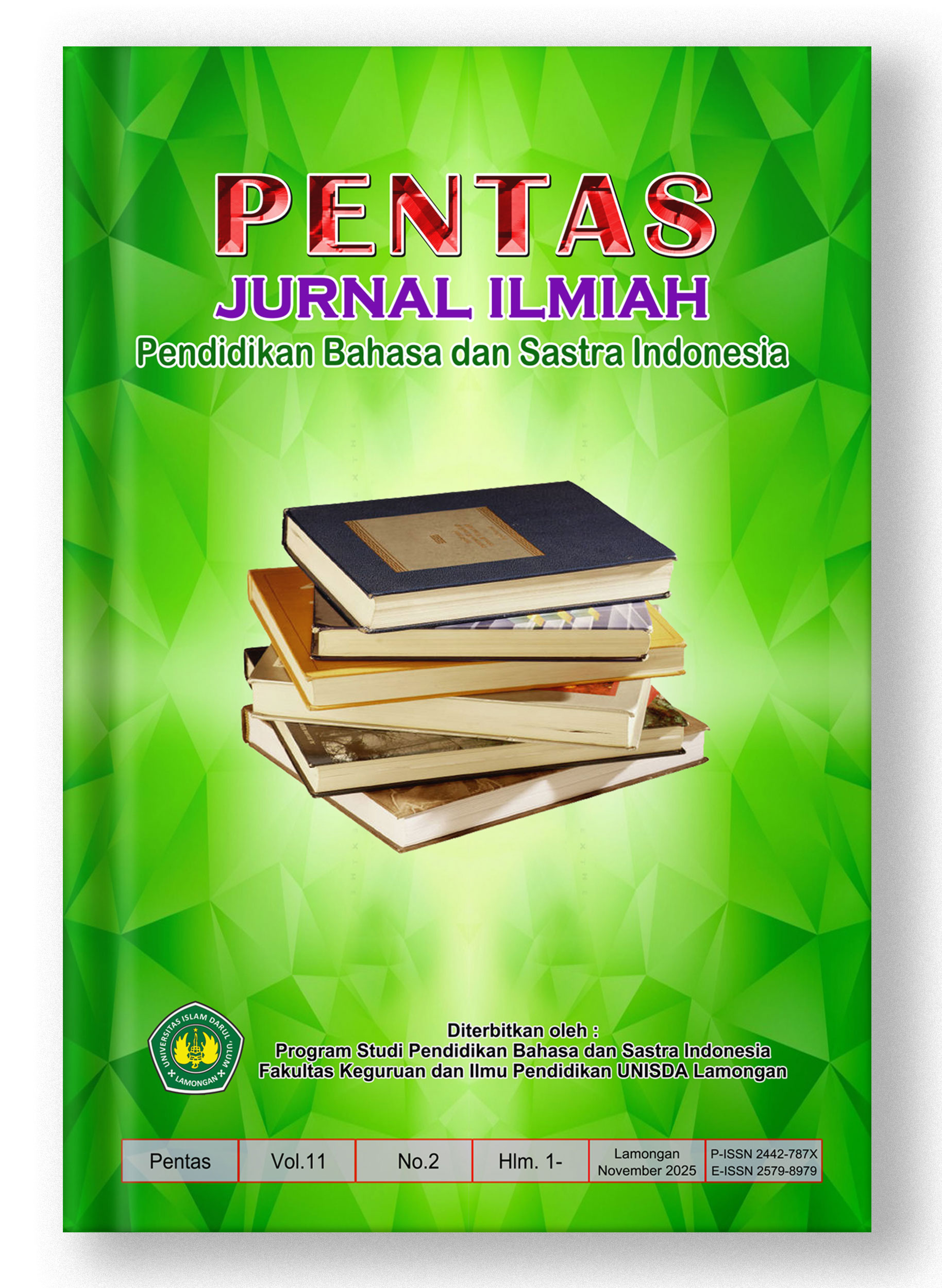
THE RELEVANCE OF LITERARY CONTENT IN INDONESIAN LANGUAGE TEXTBOOKS FOR JUNIOR HIGH SCHOOLS (SMP) MERDEKA CURRICULUM TO THE PROFILE OF PANCASILA STUDENTS
Abstract
The Merdeka Curriculum emphasizes learning flexibility, student differentiation, and character development through the implementation of the Pancasila Student Profile. In this context, textbooks play an essential role as a medium for shaping values, knowledge, and skills. Literary works in Indonesian language learning function not only as reading materials but also as media for developing moral and aesthetic sensitivity. This study aims to analyze the literary content in the Grade VIII Indonesian language textbook of the Merdeka Curriculum and its relevance to the six dimensions of the Pancasila Student Profile. Using a qualitative approach and content analysis method on two short stories and eight poems, the results show that 53 out of 184 pages (28.80%) contain literary materials. The literary texts contribute to fostering students’ sense of humanity, faith, and creativity. The most dominant dimensions represented are “Faith in God Almighty and Noble Character” and “Creativity,” while “Mutual Cooperation” and “Global Diversity” are less represented.
Downloads
References
Hartati, T., Pratami, F., & Hayati, M. (2022). Gaya Bahasa Perbandingan dalam Kumpulan Cerpen 11:11 Karya Fiersa Besari. Seulas Pinang: Jurnal Pendidikan Bahasa dan Sastra Indonesia, 4(2), 46–55.
Hartati, T. (2023). Kurikulum Merdeka. Yogyakarta: Hikam Pustaka.
Herdiansyah, H. (2021). Profil Pelajar Pancasila Menuju Generasi Emas Tahun 2045. Surabaya: CV Pustaka Media Guru.
Hindun. (2014). Pembelajaran Apresiasi Bahasa & Kreasi Sastra Indonesia. Ciputat: Mazhab Ciputat.
Kartikasari, Y. (2015). Analisis Kelayakan Isi dan Bahasa Pada Buku Teks Bupena Bahasa Indonesia Kelas VII Kurikulum 2013 Terbitan Erlangga (Skripsi, Universitas Lampung).
Kemendikbudristek. (2022). Panduan Pembelajaran dan Asesmen Pada Kurikulum Merdeka. Jakarta: Kementerian Pendidikan, Kebudayaan, Riset, dan Teknologi Republik Indonesia.
Kementerian Pendidikan, Kebudayaan, Riset, dan Teknologi. (2021). Bahasa Indonesia Untuk Siswa SMP Kelas VIII. Jakarta: Pusat Perbukuan.
Khumairoh, E. (2019). Pengaruh Buku Pelajaran Terhadap Prestasi Belajar Siswa di MI Munawariyah (Skripsi, UIN Raden Fatah Palembang).
Krippendorff, K. (2018). Content Analysis: An Introduction to Its Methodology (4th ed.). Thousand Oaks, CA: Sage Publications.
Lestari, D. (2022). Analisis Penerapan Pembelajaran Berbasis Proyek Pada Materi Teks Eksposisi di SMP. Jurnal Pendidikan Bahasa dan Sastra Indonesia, 7(2), 145–156.
Lutfia, A., Fidhyallah, N. F., & Zakiyah, R. (2024). Kajian Kurikulum. Jawa Tengah: Eureka Media Aksara.
Mulkayat. (2022). Pemaknaan Terhadap Puisi-Puisi dalam Kumpulan Puisi Kolam karya Sapardi Djoko Damono: Kajian semiotika C.S. Peirce (Skripsi, STKIP PGRI Pacitan).
Muslich, M. (2010). Textbook Writing: Dasar-Dasar Pemahaman, Penulisan, dan Pemakaian Buku Teks. Yogyakarta: Ar-Ruzz Media.
Nurgiyantoro, B. (2019). Teori Pengkajian Fiksi. Yogyakarta: Gadjah Mada University Press.
Nuryani, M., Fitriyah, Z. A., & Nurjanah, N. (2018). Representation of Islamic Culture in Textbooks at Islamic Boarding Schools: Study on Textbooks at Pondok Modern Darussalam Gontor. In Proceedings of the International Conference on Recent Innovation (ICRI 2018) (pp. 1386–1393). SCITEPRESS.
Pradopo, R. D. (2021). Beberapa Teori Sastra, Metode Kritik, dan Penerapannya. Yogyakarta: Gadjah Mada University Press.
Putri, A. M. (2021). Representasi Materi Sastra dalam Buku Teks Bahasa Indonesia SMP Kurikulum 2013. Bahtera: Jurnal Pendidikan Bahasa dan Sastra Indonesia, 5(1), 33–44.
Rahmawati, N. (2023). Implementasi Project-Based Learning Dalam Pembelajaran Teks Prosedur Pada Kurikulum Merdeka. Jurnal Inovasi Pendidikan Bahasa Indonesia, 9(1), 78–89.
Siregar, R. (2024). Penerapan Project-Based Learning Pada Pembelajaran Teks Laporan Hasil Observasi di SMA. Lingua Educatica: Jurnal Pendidikan Bahasa dan Sastra, 12(1), 50–62.
Susanti, E. (2020). Keterampilan Menyimak. Bogor: Penerbit In Media.
Syahfitri, D. (2018). Teori Sastra: Konsep dan Metode. Yogyakarta: Pustaka Ilmu.
Tuerah, R. M. S., & Tuerah, J. M. (2023). Kurikulum Merdeka dalam Perspektif Kajian Teori: Analisis Kebijakan untuk Peningkatan Kualitas Pembelajaran di Sekolah. Jurnal Ilmiah Wahana Pendidikan, 9(19).
Wellek, R., & Warren, A. (2016). Teori Kesusastraan (Cet. ke-6). Jakarta: Gramedia Pustaka Utama.
Wicaksono, A. (2017). Pengkajian Prosa Fiksi (Edisi revisi). Yogyakarta: Garudhawaca.

This work is licensed under a Creative Commons Attribution-ShareAlike 4.0 International License.
Authors who publish with PENTAS agree to the following terms:
Authors retain copyright and grant the Engagement right of first publication with the work simultaneously licensed under a Creative Commons Attribution License (CC BY-SA 4.0) that allows others to share (copy and redistribute the material in any medium or format) and adapt (remix, transform, and build upon the material) the work for any purpose, even commercially with an acknowledgement of the work's authorship and initial publication in PENTAS .
Authors are able to enter into separate, additional contractual arrangements for the non-exclusive distribution of the journal's published version of the work (e.g., post it to an institutional repository or publish it in a book), with an acknowledgement of its initial publication in PENTAS .
Authors are permitted and encouraged to post their work online (e.g., in institutional repositories or on their website) prior to and during the submission process, as it can lead to productive exchanges, as well as earlier and greater citation of published work (See The Effect of Open Access).
This work is licensed under a Creative Commons Attribution-ShareAlike 4.0 International License.