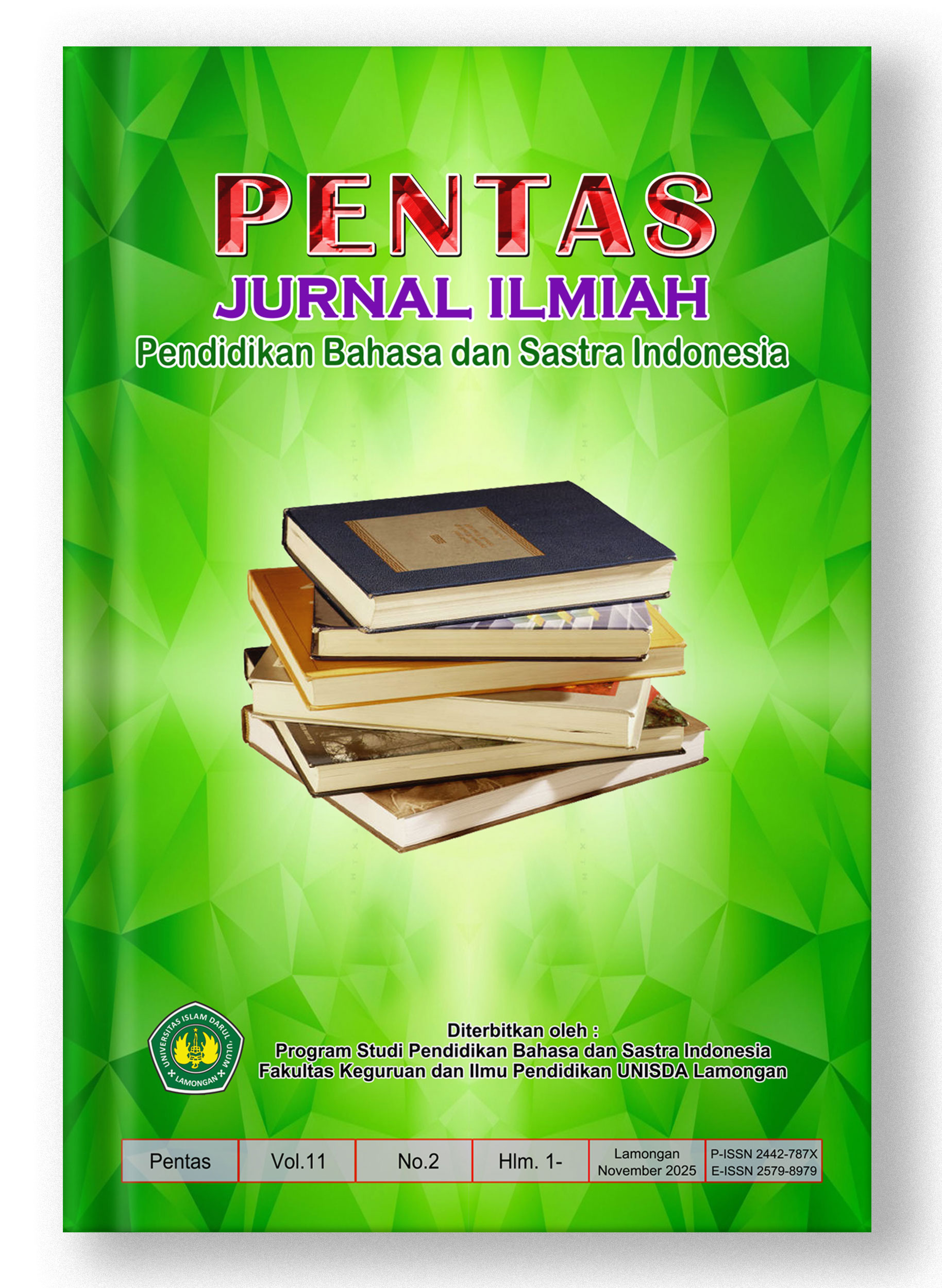
The Process and Impact of Learning to Write Anecdotal Texts through Problem Based Learning Assisted by Dart Board Media
DOI:
https://doi.org/10.52166/pentas.v11i2.11041Keywords:
Problem Based Learning Model, Dart Board, Anecdotal Text, Creative ThinkingAbstract
This study explores the implementation of Problem-Based Learning (PBL) supported by Dart Board media in teaching anecdotal text writing to develop students’ creative thinking skills. The research aims to describe both the instructional process and the impact of PBL with Dart Board media on students’ anecdotal writing. A qualitative research design was employed, involving classroom observations, interviews, and document analysis conducted in one senior high school in Padalarang. The participants consisted of 31 students. Data were analyzed through data reduction, display, verification, and cyclical coding across two instructional cycles. The findings indicate that the application of PBL assisted by Dart Board media positively influenced the learning process, as reflected in increased student participation, greater diversity of ideas, and improved originality in students’ anecdotal texts. However, the study also identified challenges, particularly the extended instructional time required for effective implementation. These findings suggest that while PBL integrated with interactive media has strong potential to enhance creative writing skills, careful consideration of time management and classroom space is essential to maximize its effectiveness. Overall, this study supports the use of interactive and problem-based instructional strategies to foster creativity in writing instruction
Downloads
References
Barrows, H. S. (1986). A taxonomy of problem-based learning methods. Medical Education, 20(6), 481–486. https://doi.org/10.1111/j.1365-2923.1986.tb01386.x
Guilford, J. P. (1950). Creativity. American Psychologist, 5(9), p444. https://doi.org/10.1037/h0063487
Hasanah, H., Faizi, N., & Wijaya, A. (2023). Perkembangan kreativitas peserta didik: Tinjauan literatur dalam konteks kehidupan abad ke-21 143-154. Pionir: Jurnal Pendidikan, 12(3), 143–154.
Marwah, A. S., & Wally, P. (2024). Pengembangan Media Pembelajaran Dart board Berbasis Problem Based Learning pada Mata Kuliah Botani Herbal. Jurnal Biology Science & Education, 13(2), 172–183.
Maulita, Z. A. P., & Arsanti, M. (2024). Permasalahan Dalam Pendidikan Pada Pembelajaran Bahasa Indonesia Di Era Digital. Jurnal Akselerasi Merdeka Belajar Dalam Pengabdian Orientasi Masyarakat (AMPOEN): Jurnal Pengabdian Kepada Masyarakat, 2(1b), 307–311. https://doi.org/10.32672/ampoen.v2i1b.1949
Rizana, R. (2022). The Effect of Problem based Learning and Creativity Model on Writing Skills of Anecdotal Texts of Students of Grade X SMA Negeri 1 Lubuk Sikaping. In Eleventh International Conference on Languages and Arts (ICLA 2022), 60–70. https://doi.org/https://doi.org/10.2991/978-2-38476-124-1_10
Roskawati, H. (2022). Penerapan Model Problem Based Learning Untuk Meningkatkan Keaktifan Belajar Peserta Didik. BULLET : Jurnal Multidisiplin Ilmu, 01(5), 860–870.
Rostikawati, Y. (2024). Problem-Based Learning Untuk Meningkatkan Keterampilan Menulis Teks Diskusi. Literasi, 14(1), 307–319. https://doi.org/10.23969/literasi.v14i1.10600
Sari, amanda woro, & Rigianti, henry aditia. (2023). Penggunaan Model Problem Based Learning (PBL) terhadap Kemampuan Berpikir Kreatif Dalam Pembelajaran IPS Sekolah Dasar. Caruban: Jurnal Ilmiah Pendidikan Dasar, 6(3), 367–376. https://doi.org/10.33603/caruban.v6i3.p367-376
Savery, J. R. (2006). Overview of problem-based learning. Interdisciplinary Journal of Problem-Based Learning, 1(1), 9–20. https://doi.org/10.62951/prosemnasipi.v1i1.17
Sitorus, B., Nasution, T. A., & Saragih, R. (2024). Penerapan Model PBL (Problem Based Learning) Terhadap Kemampuan Menganalisis Teks Anekdot Di Kelas X SMK Negeri 1 Pematangsiantar. Artikulasi: Jurnal Pendidikan, 5(2), 1–16. https://doi.org/10.36985/hkg18a53
Sukmadana, I. W. A., & Sudarti, N. W. (2024). Pembelajaran berdiferensiasi sebagai upaya menguatkan profil pelajar pancasila dalam Kurikulum Merdeka. In Prosiding Seminar Nasional Ilmu Pendidikan, 145–156.
Tajiyah, ayi, Nurhayatin, T., & Budiarti, A. (2025). Penerapan Model Problem Based Learning Dalam Menulis Teks Prosedur Untuk Meningkatkan Kemampuan Kolaboratif dan Berpikir Kreatif Peserta Didik Kelas XI SMP Negeri 1
Dayeuhkolot Kabupaten Bandung. Wistara: Jurnal Pendidikan Bahasa Dan Sastra, 6(1), 69–80. https://doi.org/10.23969/wistara.v6i1.17983
Torrance, E. P. (1966). Torrance Tests of Creative Thinking. Educational and Psychological Measurement. https://psycnet.apa.org/doi/10.1037/t05532-000
Ulger, K. (2018). The Effect of Problem-Based Learning on the Creative Thinking and Critical Thinking Disposition of Students in Visual Arts Education. Interdisciplinary Journal of Problem-Based Learning, 12(1). https://doi.org/10.7771/1541-5015.1649
Downloads
Published
How to Cite
Issue
Section
License
Authors who publish with PENTAS agree to the following terms:
Authors retain copyright and grant the Engagement right of first publication with the work simultaneously licensed under a Creative Commons Attribution License (CC BY-SA 4.0) that allows others to share (copy and redistribute the material in any medium or format) and adapt (remix, transform, and build upon the material) the work for any purpose, even commercially with an acknowledgement of the work's authorship and initial publication in PENTAS .
Authors are able to enter into separate, additional contractual arrangements for the non-exclusive distribution of the journal's published version of the work (e.g., post it to an institutional repository or publish it in a book), with an acknowledgement of its initial publication in PENTAS .
Authors are permitted and encouraged to post their work online (e.g., in institutional repositories or on their website) prior to and during the submission process, as it can lead to productive exchanges, as well as earlier and greater citation of published work (See The Effect of Open Access).

This work is licensed under a Creative Commons Attribution-ShareAlike 4.0 International License.