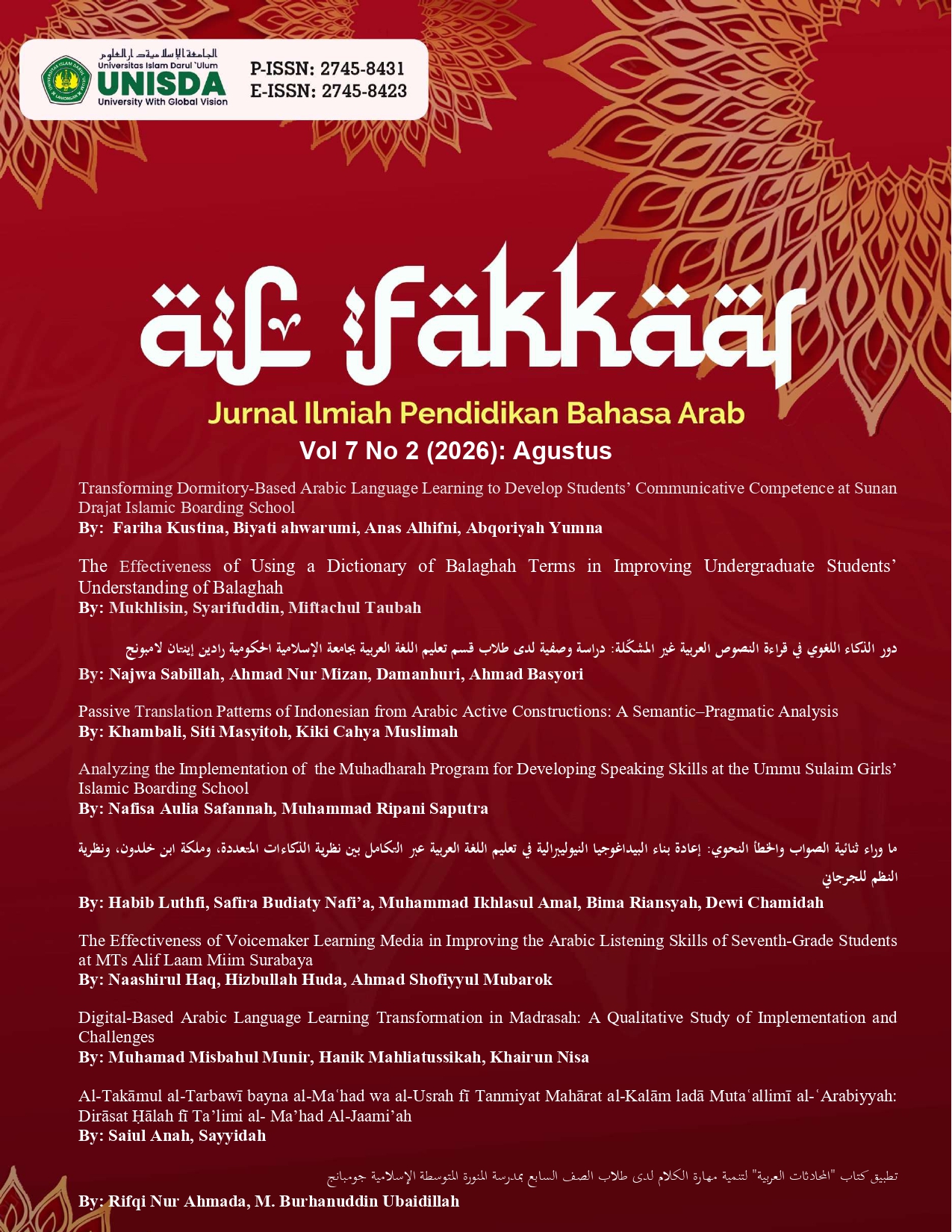
Analyzing the Implementation of the Muhadharah Program for Developing Speaking Skills at the Ummu Sulaim Girls’ Islamic Boarding School
Keywords:
Arabic language educationAbstract
This study aims to analyze the implementation of the muhadharah program as an effort to develop the Arabic speaking skills (maharah kalam) of female students at Ummu Sulaim Girls' Islamic Boarding School. A qualitative case study approach was employed using observations, semi-structured interviews, and documentation as data collection techniques. The findings reveal that the implementation of the muhadharah program consists of three interconnected stages: planning, implementation, and evaluation. The program has contributed positively to improving students' self-confidence, vocabulary acquisition, and willingness to speak in public. Nevertheless, the findings indicate that the improvement of speaking competence has not yet reached an optimal level because the learning process remains predominantly oriented toward memorization-based speech delivery. Such an approach enables students to reproduce prepared texts accurately but provides limited opportunities to develop spontaneous oral communication, interactive language use, and communicative fluency, which are essential components of maharah kalam. Furthermore, the effectiveness of the program is influenced by several supporting factors, including a conducive Arabic-speaking environment, consistent scheduling, and guidance from supervisors. Conversely, limited vocabulary mastery, students' anxiety when speaking, and the lack of varied communicative teaching strategies constitute the primary obstacles to achieving better learning outcomes. These findings suggest that the effectiveness of the muhadharah program depends not only on the continuity of its implementation but also on the pedagogical approaches adopted during the learning process. Therefore, integrating communicative language teaching strategies, interactive speaking activities, and performance-based assessment is recommended to maximize students' speaking proficiency. This study contributes to the literature by providing an empirical analysis of the implementation of the muhadharah program in a female Islamic boarding school context and by identifying pedagogical aspects that require improvement to optimize the development of Arabic speaking skills. The findings may serve as a practical reference for Islamic boarding schools and Arabic language educators in designing more communicative and effective speaking development programs.
Downloads
References
Al-mubassyir, M. (2023). Prinsip Pembelajaran Bahasa Arab Daring Perspektif Rusydi Ahmad Thu ’ aimah. Arabi : Journal of Arabic Studies, 8(1), 80–94.
Alwi, M. (2023). Pembelajaran Bahasa Arab di Kelas 5 Madrasah Ibtidaiyah Darul Ulum Kota Cirebon Tahun Ajaran 2022/2023. Fashluna Jurnal Pendidikan Dasar Dan Keguruan, 146–157.
Amanah, T. R., Kustati, M., & Gusmirawati. (2024). Pelatihan Bahasa Arab Dasar Menggunakan Metode Tat ’ biq Pada Mahasiswa PAI Universitas Negeri Padang. MATAPPA : Jurnal Pengabdian Kepada Masyarakat, 7, 9–14.
Anggraeni, F. P., Mus, & Ayyadah. (2022). Pengembangan Keterampilan Berbahasa Melalui Pendekatan Active Learning Anak Tk Bina Kalam Kecamatan Pakong Kabupaten Pamekasan. Tinta Emas Jurnal Pendidikan Islam Anak Usia Dini, 1(2), 101–112.
Chou, M. (2021). An integrated approach to developing and assessing EFL students’ speaking ability and strategy use. Language Education & Assessment, 4(1), 19–37. https://doi.org/https://doi.org/10.29140/lea.v4n1.428
Edi, R. N. (n.d.). Pendekatan Komunikatif (al Madkhol al-Ittisholi) dalam Pembelajaran Bahasa Arab. Neliti. https://media.neliti.com/media/publications/74272-ID-pendekatan-komunikatif-al-madkhol-al-itt.pdf
Fadli, M. R. (2021). Memahami Desain Metode Penelitian Kualitatif. Humanika, Kajian Ilmiah Mata Kuliah Umum, 21(1), 33–54. https://doi.org/10.21831/hum.v21i1.
Fauziyah, F., Royani, I., Triawan, A., Nabil, M. I., & Ungu, N. K. (2024). Implementation Contextual Teaching Learning to Improve Students ’ Speaking Skill. Journal of Language Education (JoLE), 2(4), 328–332.
Hafidz bin Zaid, A., Fakhiroh, A. Z., & Sonia, E. (2022). The Problems and Solutions of Thailand students’ Arabic Speaking Skills at Darussalam Modern Islamic Boarding School. Al-Ta’rib : Jurnal Ilmiah Program Studi Pendidikan Bahasa Arab IAIN Palangka Raya, 10(1). https://doi.org/https://doi.org/10.23971/altarib.v10i1.3870
Jannah, M., & Zubir, M. (2025). Cara Mudah Kuasai Kosakata Bahasa Arab Di Pesantren Syamsuddhuha Dewantara Kabupaten Aceh Utara. Ameena Journal, 3(3), 299–311. https://doi.org/https://doi.org/10.63732/aij.v3i3.238
Kartika, M., Khoiri, N., Sibuea, N. A., & Rozi, F. (2021). LEARNING BY DOING, TRAINING AND LIFE SKILLS. JURNAL MUDABBIR, 1(2), 91–103.
Kazanskaia, A. N. (2025). Evaluating Coaching Effectiveness in Public Speaking Development. NEYA Global Publishing. https://doi.org/10.64357/neya-gjnps-cchpbspdvsklconfoth-12%0A%0A
Lintang, D. (2023). Bahasa Arab Sebagai Identitas Budaya Islam dan Pemersatu Keberagaman Suku. Ta’limi: Journal of Arabic Education & Arabic Studies, 2(1), 73–86.
Mutia, F., & Hasaniyah, N. (2024). Pelatihan maharah kalam santri melalui pelaksanaan kegiatan muhadharah di Pondok Pesantren Tarbiyatul Iman Malang. Maliki Interdisciplinary Journal (MIJ), 2(8), 209–216.
Rachmawati, S. A., Elmubarok, Z., & Nawawi, M. (2023). Analisis kesulitan penguasaan kosakata bahasa arab pada siswa. Lisanul Arab: Journal of Arabic Learning and Teaching, 12(1), 46–50.
Resta, C. A., Nur, T., & Herdiana, Y. (2022). Pembiasaan Kegiatan Muhadharah Sebagai Upaya Meningkatkan Percaya Diri Siswa di MAN 2 Karawang. Islamika Jurnal Keislaman Dan Ilmu Pendidikan, 4, 743–753.
Rizqi, M. R. (2021). UPAYA MENINGKATKAN KEMAMPUAN BERBICARA BAHASA ARAB DENGAN MENGGUNAKAN MEDIA FLIP CHART BAGI SISWA KELAS VIII MADRASAH TSANAWIYAH “ FADLLILLAH ” DESA TAMBAK SUMUR KECAMATAN WARU KABUPATEN. Al-Fakkaar: Jurnal Ilmiah Pendidikan Bahasa Arab, 2(1), 1–21.
Sugiyono. (2013). METODE PENELITIAN KUANTITATIF, KUALITATIF DAN R &. D (13th ed.). ALFABETA, CV.
Suryani, T. Z. (2025). Model - Model Pengembangan Keterampilan Berbicara Bahasa Arab Berbasis Media Film bagi Tingkatan Mubtadi ’ in. Edukatif: Jurnal Ilmu Pendidikan, 7(5), 1261–1270.
Thompson, R. F. (2010). Habituation: A History. Nasional Institutes Health, 92(2), 127–134. https://doi.org/10.1016/j.nlm.2008.07.011.Habituation
Tungkagi, F. M., Ali, I., & Kasan, Y. (2022). PROBLEMATIKA PEMBELAJARANBAHASA ARABPADA MAHASISWA LULUSAN NON-MADRASAHDI PRODIPENDIDIKAN BAHASA ARABIAIN SULTAN AMAI GORONTALO. Al-Fakkaar: Jurnal IlmiahPendidikan BahasaArab, 3(1), 1–16.
Umroh, I. L., Ibrahim, F. M. A., & Arifah, Z. (2026). The Influence of Self-Confidence on Arabic Writing Skills at Kiai Abdullah Faqih University Gresik. ALSUNIYAT: Jurnal Penelitian Bahasa, Sastra, dan Budaya Arab, 9(1), 30-44.
Wulandari, T., Garzita, R. V., & Nasution, S. (2025). Faktor Psikologis yang Mempengaruhi Maharah Kalam Mahasiswa Pendidikan Bahasa Arab UIN SU Medan. Jurnal Sadewa: Publikasi Ilmu Pendidikan, Pembelajaran Dan Ilmu Sosial, 3, 304–316.
Younas, M., El-dakhs, D., Anwar, B., & Jinag, Y. (2025). Motivational role of teachers in developing English speaking skills of Pakistani university students. September, 1–11. https://doi.org/10.3389/feduc.2025.1626602
Yunita, Y., & Pebrian, R. (2020). Metode Komunikatif dalam Pembelajaran Bahasa Arab Maharah Al-Kalam di Kelas Bahasa Center for Languages and Academic Development. Jurnal UIR, 5(2). https://doi.org/10.25299/al-thariqah.2020.vol5(2).5838
Downloads
Published
How to Cite
Issue
Section
License
Copyright (c) 2026 Al-Fakkaar

This work is licensed under a Creative Commons Attribution-ShareAlike 4.0 International License.